
Flagging the challenge of raising foodgrain production, Prime Minister Manmohan Singh on Friday promised all assistance to states for improving agricultural growth.
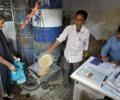
The Pradhan Mantri Garib Kalyan Anna Yojana (PMGKAY) was launched in March 2020 to provide free 5 kg foodgrains per person per month to about 80 crore beneficiaries covered under the National Food Security Act (NFSA) to reduce their hardship during the lockdown period. This was over and above the general allocation under the NFSA.

Ushering in the biggest programme in the world to fight hunger, Parliament on Monday gave its nod to the landmark Food Security Bill which seeks to provide highly subsidised foodgrains to the country's two-third population as a right.
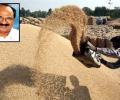
Justifying the United Progressive Aliance government's decision to bring the food security bill through an ordinance, Union Food Minister K V Thomas on Thursday said the Centre is confident that it will be ratified in the monsoon session of Parliament commencing on August 5.
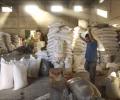
There are about 500,000 fair price shops in states and UTs combined.

Finance Minister Nirmala Sitharaman has brought down the budgetary allocation for the fertiliser subsidy for FY21 to Rs 71,309 crore, from the RE of Rs 79,998 crore for FY20, while increasing food subsidy to FCI through "ways and means advance" to Rs 50,000 crore for FY21, from Rs 36,000 crore in RE for FY20, and under the National Food Security Act (NFSA) to Rs 77,982 crore, from Rs 75,000 crore.

The government allowed sugar companies and distilleries to make hand sanitizers using ethanol. Sugar companies supply ethanol to oil marketing companies for blending with petrol.

A group of lawyers and activists want India's privacy law to ensure that autonomy, dignity and privacy are safeguarded, and proposes a penalty provision of up to Rs 10 million for those found violating the code and a jail term extending up to three years or a combination of both. Mayank Jain reports.

The Bharatiya Janata Party on Saturday released its manifesto for the November 17 Madhya Pradesh elections promising MSP for wheat at Rs 2,700 per quintal and paddy at Rs 3,100 and houses for beneficiaries of the state's flagship scheme 'Ladli Bahna'.
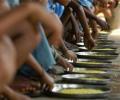
Nowhere on the planet, nowhere in mankind's history has such an idea taken the concrete shape in form of a law. The National Food Security Bill, which will come via ordinance and not after the debate in Parliament, is an incredible economic tool to tackle the hunger of poor Indians. Also, it has already been condemned widely as a political gimmick.

8 crore migrant workers will get 5 kilogram of grains per person and 1 kilogram of 'chana' for two months.

The government today decided to promulgate an ordinance to give nation's two-third population the right to 5 kgs of foodgrain every month at highly subsidised rates of Rs 1-3 per kg. The Cabinet, which had in June deferred a decision on the issue, today approved promulgating an ordinance to implement the Food Security Bill, sources said.


The government on Tuesday approved the revised Food Security Bill to provide for uniform 5 kg of foodgrains per month per person at a highly subsidised price of Rs 1 to 3 per kg to two-thirds of the country's population.
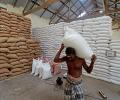
Amid the ongoing festival season and ahead of the elections for five state assemblies, the Centre is closely monitoring inflation, particularly in food items, to enable it to take steps to increase their supplies. "There is a complete no-nonsense attitude when it comes to food inflation, and instructions have been issued at all levels to be very sensitive to any possible price movements in any commodity," a senior official explained. Sources have said that all departments dealing with food items have been instructed to keep a close eye on all commodities and maintain a weekly record of their price movements.
The overall fiscal and inflationary consequences of the Food Security Bill for the country are "large" and will become clear from the next fiscal year.
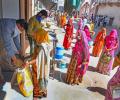
The government's subsidies on food, fertilisers and petroleum are estimated to decline by 39 per cent to Rs 4,33,108 crore this fiscal and fall further by 27 per cent to nearly Rs 3.18 lakh crore in 2022-23. In its revised Budget (RE) estimate for the 2021-22 fiscal, the government has pegged total subsidies to be at Rs 4,33,108 crore against the actual Budget estimate of Rs 7,07,707 crore in the previous financial year. Out of which, the food subsidy is estimated to decline to Rs 2,86,469 crore in the current fiscal from Rs 5,41,330 crore in 2020-21, while petroleum subsidy is estimated to fall to Rs 6,517 crore from Rs 38,455 crore in the said period.

President Pranab Mukherjee signed the ordinance on food security to give nation's two-third population the right to get 5 kgs of foodgrains every month at highly subsidised rates of Rs 1-3 per kg.

Rahul Gandhi on Wednesday said "a government of the youth" will come to power in 2014 which will work for the poor and "change" the country, comments that triggered speculation whether he would take a leading role after the next polls.

PDS: Smart ration cards need to be smarter

Agriculture credit jumped seven-fold to Rs 7,00,000 crore (Rs 7 trillion) in the past ten years of UPA government, boosting foodgrains output to a record and enabling enactment of food law.

On reforms in pipeline, she said the government is for universal right to minimum wages and wants to remove regional disparity through a national floor wage.
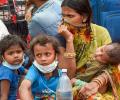
Only two in every five migrants said they received ration or cooked food from the administration either daily or at times.

Nationalist Congress Party Supremo and Agriculture Minister Sharad Pawar has dismissed the possibility of early general elections in view of government issuing food security ordinance, saying the "question does not arise unless and until the food reaches the people".
Indian farming was transformed after the mid-60s.

According to the food ministry, about 142 lakh migrants will benefit in Uttar Pradesh and in Bihar (86.45 lakh), Maharasthra (70 lakh), West Bengal (60.1 lakh), Madhya Pradesh (54.64 lakh), Rajasthan (44.66 lakh), Karnataka (40.19 lakh), Gujarat (38.25 lakh), Tamil Nadu (35.73 lakh), Jharkhand (26.37 lakh), Andhra Pradesh (26.82 lakh) and Assam (25.15 lakh).
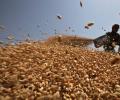
To ensure enough food to the poor during the lockdown, the government last week started distributing free 5 kg of rice or wheat per person and 1 kg pulse per household under the Pradhan Mantri Garib Kalyan Yojana to over 81 crore PDS beneficiaries.
The ordinance on the Food Security Bill is expected to come up for consideration in the Lok Sabha on Wednesday, sources said on Monday.

With Lok Sabha polls not too far away, Congress President Sonia Gandhi signalled that the ambitious Food Security and Land Acquisition Acts brought in by the Centre would give a new deal to the people, especially the farmers and the poor.

The government on Thursday sent the ordinance on food security to President Pranab Mukherjee for his consent.
The much-touted Food Security Bill, which proposes to give the country's three-fourth population the right to highly-subsidised food, was introduced in the Lok Sabha on Wednesday, with the government rejecting apprehensions that it would impinge upon the rights of states.

Addressing a separate session on world food security, Thomas said that India's food law marks a paradigm shift in approach to food security -- from being a welfare measure to rights-based approach.
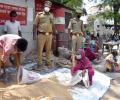
A recent study shows that more than 100 million people are excluded from the public distribution system because the central government insists on using 2011 population figures to calculate state-wise PDS coverage, which effectively leaves out 100 million people, reports Sanjeeb Mukherjee.

As hard bargains continue for the next four days at the picturesque tourist resort of Indonesia, the ministers., including from the influential developed countries will try and reach agreements on providing windows to the developing nations for their food security programmes and a pact to free the global trade from the procedural hassles at the customs.

EY said out of the nearly Rs 21 lakh crore package, Rs 8.01 lakh crore is on account of liquidity enhancing measures taken by the RBI since February.
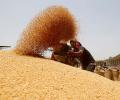
'All imaginary figures are pushed by government bureaucrats.' 'They never showed that the production of wheat was less this time.'

After much delay and uncertainty, the landmark Food Security Bill was passed by the Lok Sabha on Monday which seeks to provide cheap foodgrains to 82 crore people in the country, ushering in the biggest programme in the world to fight hunger.

'As of now, this one move seems to have precariously altered the balance of forces on the volatile ground, between separatists and the mainstream. 'The landscape today presents a fearsome picture of the future of mainstream politics in Kashmir. 'Conversely, the separatist ideology looks to have got an unearned boost,' points out Mohammad Sayeed Malik, the veteran commentator on Kashmir affairs
This is a formidable task which the Centre may find hard to shoulder without substantial involvement of the states.
